History Matching with DSS: Is Diffusion Linearly Additive?
The linearity of diffusion
I learned how diffusion works in MOOSE and how the variables are coupled in the MOOSE framework. I then know whether they are linearly addable or not.
The classical diffusion (one-way coupled)
The governing equation for the pressure diffusion is:
\[\frac{\partial p}{\partial t} = \frac{k}{\mu\phi c_t}\nabla p\]where $D = \frac{k}{\mu\phi c_t}$ is the hydraulic diffusivity.
After we solve the pressure equation, we need to solve a simplified version of the linear momentum conservation equation by treating the pressure gradient as a body force. The governing equation would be:
\[\nabla \cdot \sigma + F =0\]Also, using Hooke’s law with effective stress, we have the total stress tensor:
\[\sigma=C:\varepsilon -\alpha p \mathbf I\]where,
- $\mathbf{u}$ is the displacement vector (strain $\boldsymbol{\epsilon} = \frac{1}{2}(\nabla \mathbf{u} + (\nabla \mathbf{u})^T)$).
- $\mathbf{C}$ is the stiffness tensor (containing Young’s modulus $E$ and Poisson’s ratio $\nu$).
- $\alpha$ is the Biot-Willis coefficient (coupling strength).
- $\mathbf{F}$ represents body forces (like gravity).
Then we have:
\[\nabla \cdot (\mathbf{C} : \nabla \mathbf{u}) = \alpha \nabla p - \mathbf{F}\]We can see the strain is in explicit form in the momentum conservation equation.
Fully coupled hydro-mechanical model
Eq A:
\[\nabla \cdot \left( \mathbf{C} : \boldsymbol{\epsilon} - \alpha p \mathbf{I} \right) + \mathbf{F} = 0\]Same as one-way coupled. Still contains 2 variables.
Eq B:
\[\frac{1}{M} \frac{\partial p}{\partial t} + \alpha \frac{\partial \epsilon_{vol}}{\partial t} + \nabla \cdot \left( - \frac{k}{\mu} \nabla p \right) = Q\]- $\epsilon_{vol} = \text{trace}(\boldsymbol{\epsilon}) = \epsilon_{xx} + \epsilon_{yy} + \epsilon_{zz}$ is the volumetric strain.
- $M$ is the Biot modulus.
- The coupling term $\alpha \frac{\partial \epsilon_{vol}}{\partial t}$ is the squeezing effect. If the rock compresses rapidly, it squeezes fluid out, temporarily increasing pore pressure.
Currently the hydro-mechanical model (HMM) is what I’m using in MOOSE.
Linear additivity of the two types of equation
Classical diffusion
Yes, I believe it is linearly addable. Here’s the proof:
Since the strain is not time dependent (it is explicitly calculated from the pressure field), we only need to prove the linear additivity of classical pressure diffusion.
So we mark the pressure diffusion as:
\[\frac{\partial p}{\partial t} -\frac{k}{\mu\phi c_t}\nabla p =0\]We have three sets of solutions of the diffusion equation:
- $p_1(x,t_1)$ is the solution at $t_1$ (waveform at $t_1$)
- $p_2(x,t_2)$ is the solution at $t_2$ (waveform at $t_2$)
- $p_3(x) = p_1(x,t_1)+p_2(x,t_2)$
Since $p_1$, $p_2$ are solutions, we have:
\[\frac{k}{\mu\phi c_t}\nabla p_1(x,t_1) =0\]and,
\[\frac{k}{\mu\phi c_t}\nabla p_2(x,t_2) =0\]Simply adding them, we have:
\[\frac{k}{\mu\phi c_t}\nabla (p_1(x, t_1)+ p_2(x,t_2)) =0\]That means $p_3(x)$ is also a solution of the PDE.
HMM/THM
However, this does not hold for the fully coupled hydro-mechanical model.
The pressure curve — do I need to normalize?
My current answer is NO. The pressure will be coupled with the strain field (even one-way), so a normalized pressure will still make the strain inaccurate.
Next step
- I’ll use a numerical method to verify the conclusion above.
- Also, I need to adjust the kernel settings in MOOSE. Currently, these are the kernels (HMM) I’m using:
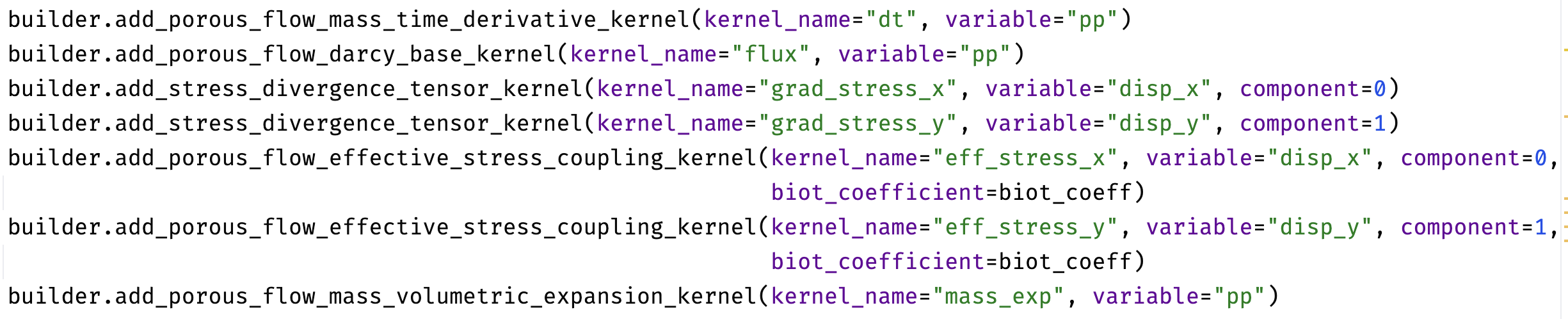
Here,
-
dp/dtwill be kept in classical diffusion. - Darcy flow: keep.
- Others: remove. They couple pressure and strain.
I need to add kernels in Python:
-
StressDivergenceTensors: $\nabla \cdot \sigma =0$ - In the material block, after defining the material in fracture & SRV, we need to define how to calculate strain from the pressure field. Still working on this; it seems I need
ComputeIsotropicElasticityTensor,ComputeSmallStrain, andComputeLinearElasticPoroelasticStress.
Enjoy Reading This Article?
Here are some more articles you might like to read next:
- Permeability Imaging via DSS Strain Inversion (Research Log)
- How to deploy a blog using the code in this repository?
- MOOSE PorousFlow: Governing Equations
- Dialogue Log: Debugging a MOOSE Script with Gemini
- fiberis.analyzer philosophy
- fiberis.moose setup
- Cement Shrinkage and Microannulus Formation in Horizontal Wells
- fiberis.moose: Programmatic MOOSE Input Generation
- Pressure Diffusion in Fractured Media
- Poisson's ratio test python code